

If you’ve ever reached out to a supplier about buying eyebrow tint in bulk and been told there’s a “minimum order quantity,” you’ve encountered one of the most common and most misunderstood parts of eyebrow tint wholesale buying.
For some buyers, MOQ feels like a barrier. For others, it’s a non-issue they barely think about. The difference usually comes down to one thing: whether or not you actually understand what MOQ means, why it exists, and how to work with it rather than around it. Whether you’re a salon owner placing your first wholesale order, a beauty retailer building out your product range, or a new reseller trying to figure out how the supply chain works this guide will give you a clear, honest picture of how minimum order quantities shape the eyebrow tint buying process from start to finish.
What Is MOQ and Why Does It Exist?
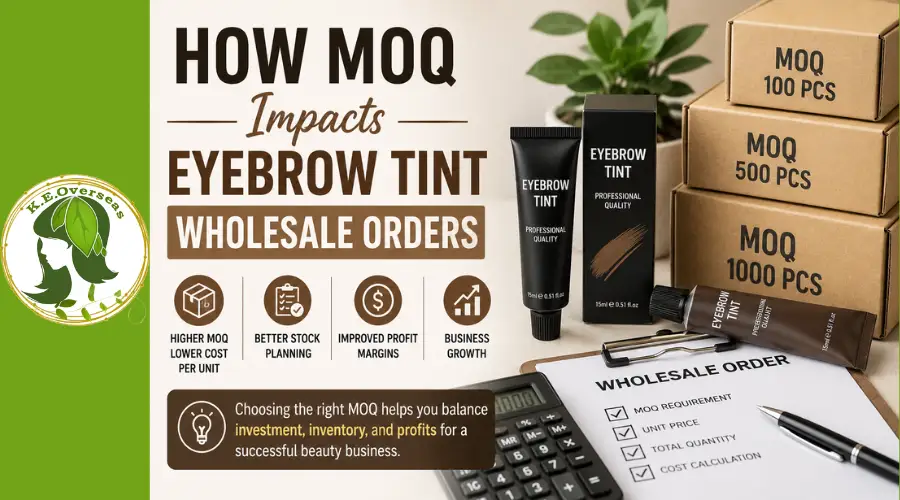
MOQ stands for Minimum Order Quantity. It’s the smallest number of units or the lowest order value that a supplier will accept for a single transaction.
So if a supplier says their MOQ is 50 units, they won’t process an order for 30. You either meet the minimum or you don’t place the order.
This isn’t suppliers being difficult. It’s economics.
Manufacturing, packing, labelling, quality checking, and shipping all cost money and much of that cost is fixed regardless of how many units are in the order. A supplier who processes a 10-unit order and a 200-unit order spends nearly the same time on paperwork, compliance checks, and logistics coordination. The per-unit cost on small orders makes them unprofitable or barely worth the effort.
MOQ protects the supplier’s margins. But when it’s set sensibly, it also benefits the buyer because it’s what allows suppliers to offer genuinely competitive wholesale pricing in the first place.
How MOQ Works in Eyebrow Tint Wholesale
The beauty industry has its own MOQ norms, and eyebrow tint is no exception. What you’ll encounter depends heavily on the type of supplier you’re dealing with.
Manufacturers tend to have the highest MOQs. They’re producing goods at scale and their pricing structure is built around large runs. If you’re sourcing directly from a factory especially overseas MOQs of several hundred to several thousand units are common. The trade-off is the lowest possible unit cost.
Distributors and wholesalers typically sit in the middle. An established eyebrow tint distributor sources from manufacturers and resells to salons, retailers, and smaller resellers. Their MOQs are usually more accessible often starting at a few dozen units because breaking bulk is part of what they do. This is why many smaller businesses prefer working with a distributor over going direct to a manufacturer.
Branded suppliers and specialist beauty wholesalers vary widely. Some cater specifically to professional buyers and have flexible MOQs as a selling point. Others have strict minimums tied to their pricing tiers. Understanding which type of supplier you’re dealing with helps you set realistic expectations before you even start a conversation.
The Real Impact of MOQ on Your Business
MOQ isn’t just a number on a price list. It has real downstream effects on how you run your business.
Cash Flow and Inventory Risk
The most immediate impact is financial. A higher MOQ means a larger upfront investment. If you’re a salon buying eyebrow tint for in-house use, ordering 200 units when you realistically use 20 a month means tying up capital in six months’ worth of stock.
For new buyers especially, this is worth thinking through carefully. Eyebrow tint products have a shelf life. Buying more than you can sell or use before the product expires is a waste not a saving.
This is why working with an eyebrow tint distributor that offers reasonable MOQs matters so much for smaller buyers. A distributor who understands their client base sets minimums that are commercially sensible, not just operationally convenient for themselves.
Pricing Per Unit
The flip side of MOQ is pricing. Higher volume orders almost always come with lower per-unit costs. If a supplier’s MOQ is 100 units at £2.50 each, they might offer 500 units at £1.90 each.
For a retailer or reseller who knows they can move volume, hitting a higher MOQ isn’t a burden it’s a margin opportunity. Every £0.60 reduction in cost per unit is pure profit on resale, assuming you can shift the stock.
The key is being honest with yourself about your actual sell-through rate before chasing the best unit price at a quantity you can’t realistically move.
Product Range Flexibility
MOQ affects how many different products you can carry. If you want to stock five shades of eyebrow tint and each shade has an MOQ of 100 units, you’re looking at a 500-unit minimum just to cover your range. Spread across multiple products, high MOQs can force buyers to narrow their range or concentrate spend on fewer lines.
Some eyebrow tint wholesale suppliers offer blended MOQs where the minimum applies across a product family rather than per shade or SKU. This is a genuinely buyer-friendly approach that makes range building more practical without eliminating the supplier’s volume requirement.
Ability to Test New Products
Launching a new brand or shade range carries risk. You don’t know how your customers will respond until the product is on the shelf or in the treatment room. A high MOQ on an untested product means significant exposure if it doesn’t land well.
This is one of the strongest arguments for working with a flexible eyebrow tint distributor particularly when you’re exploring new product lines. A supplier who offers sample orders or low-volume trial runs before you commit to a full wholesale order is one who respects the reality of the buying process.
How to Negotiate MOQ Like a Pro
MOQ isn’t always fixed. Many suppliers especially distributors who want long-term relationships are willing to discuss minimums, particularly with buyers who show genuine commercial intent.
Here’s how to approach the conversation:
Be transparent about your volume. Don’t promise order quantities you can’t deliver. Suppliers hear inflated projections all the time. A buyer who says “I realistically need 60 units a month but want to start with 40 to test the market” is far more credible than one who claims they’ll “definitely be ordering 500 units once things pick up.”
Ask about starter or trial orders. Many suppliers have an informal policy of offering reduced minimums for first orders, even if it’s not listed on their website. The worst they can say is no.
Offer something in return. If you want a lower MOQ, consider offering faster payment terms, a commitment to a repeat order within a specific timeframe, or a willingness to work exclusively with that supplier for a defined period. Flexibility works both ways.
Ask about mixed SKU options. If a single-product MOQ is too high, ask whether the minimum can be spread across multiple shades or products. This is common in the beauty sector and many suppliers accommodate it as standard. Build the relationship first. Suppliers give their best terms to buyers they trust. Paying on time, communicating clearly, and following through on commitments are the fastest ways to earn the kind of flexibility that doesn’t appear in any catalogue.
Red Flags to Watch Out For
Not every MOQ situation is a straightforward business negotiation. There are a few warning signs worth knowing.
Unrealistically low MOQs with premium pricing. If a supplier is advertising MOQs of just five units but charging close to retail price, you’re not really buying wholesale you’re buying at a markup dressed up as a trade deal.
No clarity on what happens if you fall short. Reputable suppliers are clear about their terms. If a supplier is vague about whether the MOQ is per order, per month, or per year or what happens if you occasionally order less that lack of clarity is a problem waiting to happen.
MOQs that increase without notice. Established suppliers communicate changes in advance. If you’re repeatedly discovering that minimums have shifted without being told, it’s a sign of disorganised supply chain management that will create problems as your business grows.
MOQ is one of those parts of wholesale buying that looks complicated on the surface but makes complete sense once you understand the logic behind it. It’s not there to trip you up it’s there to make the supply chain work for everyone involved.
For buyers in the beauty space, understanding MOQ means being able to have better conversations with suppliers, make smarter stocking decisions, and build supplier relationships that actually support your business goals rather than constrain them.
Whether you’re placing your first eyebrow tint wholesale order or looking to optimise an existing supply arrangement, the buyers who do best are the ones who approach MOQ as a variable to work with not a wall to push against.
The right supplier will meet you halfway. And the right terms, negotiated well, make all the difference.